Subterranean termites require continuous contact with ground soil to survive, nesting underground and constructing mud tubes over concrete foundations to access structural wood. In Sacramento County, heavy riverbank…
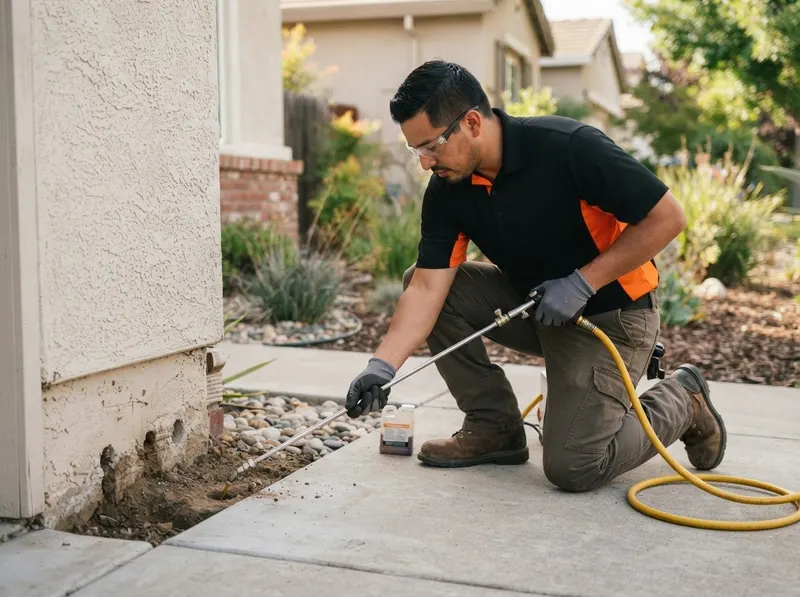
Subterranean termites require continuous contact with ground soil to survive, nesting underground and constructing mud tubes over concrete foundations to access structural wood. In Sacramento County, heavy riverbank moisture near the American River Parkway and older raised-foundation housing stock in Curtis Park, Land Park, and Midtown create elevated colonization pressure. When structural sills and floor joists meet moist soil, the resulting colony can number over 250,000 workers. Eradication relies on establishing an uninterrupted chemical barrier or placing monitoring stations that workers carry back to the primary queen, preventing structural failure without requiring whole-house fumigation tents.
Treatment selection depends entirely on foundation engineering and soil composition. A continuous liquid soil barrier uses non-repellent compounds like fipronil, which workers traverse without detection. As detailed by the California Department of Pesticide Regulation, liquid barriers require precise trenching into soil alongside foundation footers at a depth of 6 inches. For homes with attached concrete slabs, patios, or driveways, common throughout East Sacramento and South Land Park, technicians drill vertical 1/2-inch holes through concrete spaced 12 inches apart to inject the termiticide beneath the slab. Alternatively, monitoring systems registered under EPA pesticide standards offer bait matrices containing insect growth regulators like noviflumuron, which disrupt chitin synthesis and eradicate the subterranean colony over 60 to 120 days.
Environmental protection remains paramount when applying soil termiticides. According to guidelines from the California Structural Pest Control Board, liquid termiticides must never be injected within close proximity of open wells, cisterns, or standing water tables. In low-lying neighborhoods such as Pocket-Greenhaven and Natomas, high water tables demand targeted bait installations rather than high-volume liquid drenches to prevent runoff. Homeowners with raised-foundation bungalows in Tahoe Park and Oak Park require specialized crawlspace venting assessments aligned with standards from the American National Standards Institute, as poor crawlspace ventilation elevates wood moisture content above the 20 percent threshold where structural wood rot and subterranean entry accelerate.
Property owners can evaluate structural risks through pest-management literature maintained by the UC Davis IPM Program, which highlights that subterranean termites cannot digest dry sound wood without constant soil moisture. Unlike drywood species that nest entirely inside structural lumber and demand thermal or gas eradication, subterranean colonies are eliminated by severing ground access. Standards published by the Weyerhaeuser Wood Products Guide reinforce that maintaining a clear 6-inch inspection gap between bare soil and perimeter siding prevents undetected shelter tube construction. For industrial structural specifications, property managers reference the American Wood Protection Association for ground-contact retention ratings, while environmental impact assessments follow standards established by the US Geological Survey and residential building codes outlined by the International Code Council. Summit Pest Protection verifies all linear measurements on-site to balance immediate colony elimination with lasting perimeter soil stability.
Every job gets a firm, written price after a free on-site visit.
For standards, safe disposal, and service guidance on PEST CONTROL SEVICE in Sacramento, CA, useful references include U.S. EPA, ENERGY STAR, U.S. Dept. of Energy, Consumer.gov, U.S. Census Bureau, and Google Maps. General consumer and small-business resources are available from USA.gov, Better Business Bureau, FTC Consumer Advice, U.S. Small Business Administration, and Ready.gov.
Tell us about your subterranean termite treatment job in Sacramento and we'll send a clear, written quote, usually the same day.
 Summit Pest Protection